It’s all about finding your center. (Or something like that.)
Where is the center? In the middle, right? So how can the center be around something? Aren’t these two concepts a bit of an oxymoron when placed next to each other? You’re either at the center or you’re around. Will everyone please stop saying and writing “centered around” now?
If your grandmother installed certain values in you, I have to ask… are you an android of some sort? Was your kindness downloaded? Was your generosity transferred via a floppy disk? Do you see the difference a single letter can make?
If you are blessed with curly, you want straight; if you’re blessed with straight, you want curly. Oh, wait, you think I’m talking about hair? Nope. Let’s talk quotation marks, folks.
Someone recently asked, “Grammar mistress, what’s the difference between straight vs. curly quotation marks?” A couple things about this question make me happy. First, I’m kind of digging “grammar mistress,” and second, these are the subtleties that no one ever seems to talk about. So let’s talk about it.
This poor guy. Was he dragged or drug? (Or drugged?)
If drag racing happened yesterday, would it be drug racing? No, that’s not right, though there’s definitely a bad pun of a book idea somewhere in there.
Shoo, shoe. Stop photobombing the picture! (A shoo-in for a photography award? Probably not.)
Are we talking about wedging a foot into a doorway or about shooing something in a certain direction? Do you know?
When this expression is spelled wrong, it’s almost justifiable. To “get a foot in the door” is a common idiom, and this one could be related… But it’s not.
You know who’s tired of this confusion? This guy. (If there was ever a bird to know his Shakespeare, this is the one.)
Perhaps with birds of prey, you might have a “fowl swoop.” Perhaps with gangly young basketball players, you might have a “foul swoop.” But when you’re looking for what to call a sudden, swift action, “fell swoop” is the correct form. How many of you are writing this one right?
Asterisk is one of those words that you just can’t say ten times fast. Try it. I’ll wait…
How’d it go? Turn any heads? Get any “bless you”s?
There are risks to the asterisk*—and not only in saying it correctly with any amount of speed. Asterisks muffle curses, and they are often followed by daggers. And if that doesn’t sound like the start of a really bad grammarian murder mystery, I don’t know what is.
When to use an asterisk
When replacing letters in words (such as curse words) or names you don’t want to spell out (e.g., “wow, what a grammar b**** that Kris is” or “From your secret crush, K***”)
When pointing a reader to further information, as in a footnote.
When showing the passage of time in the case of a section break in a story.
I’m sure there’s a good kissing emoticon out there with an asterisk, right?
Your answers: In extremely casual cases, you can get away with “nite,” but note, I’m saying “extremely casual.” Personally, I’d recommend avoiding it at all costs (this spelling makes some people—like yours truly—cringe), but if you’re texting a friend, I suppose this spelling is okay.
However, “nite,” like “lite,” is not an acceptable Scrabble word.
Contrary to first instincts to blame our messy texting and social media posting culture, “nite” has been around for well over 100 years, at least as early as the 1870s. But even with this history, it has never been accepted as a standard form.
And please for the love of words, never say anything about a “nite in shining armor.” That’s just crazy talk. You know better than that.
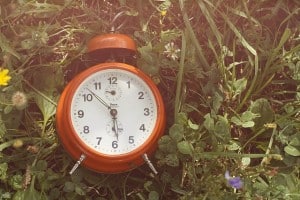
Is your alarm clock set for 6am, 6AM, 6 A.M., or 6 a.m? (Don’t mind me; I’m just hitting the snooze button while you ponder that one.)
Meanwhile, what’s up with this clock? Is it the white rabbit’s? There’s a story here…
The answer here brings out the Latin dictionaries. This is an abbreviation, after all, just like “i.e.” or “e.g.” When it comes to time, “a.m.” stands for ante meridiem or “before noon,” and “p.m.” stands for post meridiem or “after noon.” So for those of you paying attention, you’ve figured out the answer.
The above time is correctly written as “6 a.m.” Notice the space between the number and the abbreviation? That’s a part of the correct answer too.
In an era of quick emails, writing the time as “10am” or “4pm” has been gaining popularity, but there are a lot of sticklers out there about this one. Give the numbers some space. Give the abbreviations the periods. Keep it in lower case, folks.
“Anytime” is a relatively new word—yes, we’re calling early 20th century “recent” for the sake of this linguistic argument. And you know that any time there is a new word, there’s going to be a grammarian hullaballoo. Here’s just another example.
When does he walk in the middle of the road? Anytime he wants to. He’s a rebel like that. Linguistic and otherwise.
“Anytime” (one word) is considered a casual form, not one for your résumé or emails to advance you up the corporate ladder. In fact, this one-word form is still not recognized by some dictionaries. (I’m looking at you, OED). “Anytime” technically is defined as an adverb meaning “whenever” or “on any occasion,” but as a new word, it is young and defiant, having other meanings too. “Anytime” can also simply mean “No problem,” in response to a “thank you.”
If you aren’t sure if you can get away with “anytime” vs. “any time,” ask yourself if you can replace the word in question with “at any time.”

 If your grandmother installed certain values in you, I have to ask… are you an android of some sort? Was your kindness downloaded? Was your generosity transferred via a floppy disk? Do you see the difference a single letter can make?



 Asterisk is one of those words that you just can’t say ten times fast. Try it. I’ll wait…
 Is “nite” ever right? Can you get away with it in