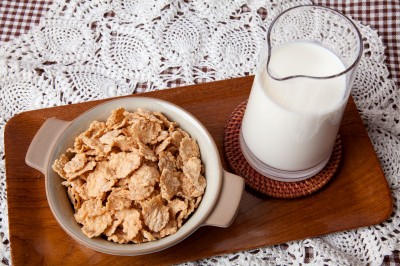
One of these phrases could be used when you’re intensely studying something; the other is what you do when you add milk to your cereal.
“To Pore,” meaning to meditate deeply, was once a commonly used verb, but it’s fallen out of fashion along with the popularity of Roman numerals and illuminated manuscripts. This sense of “pore” most likely derived from two Old English words: spyrian, a verb meaning “to investigate” and spor, a noun meaning “a trace, vestige.” The contemporary phrase “to pore over” is really this old verb’s last burst of life, so it’s time for us to respect our elders. Don’t confuse this historical word with a splash over your morning Wheaties. Am I right?
If a pathological liar tells stories, are they fictional or fictitious? If those stories are then published, does the word choice need to change?
Here’s a subtle one for you. Both “fictional” and “fictitious” share a common root, but there is a difference in their definitions. Fiction, of course, is imaginary or fabricated, but something is described as “fictional” when it relates to a work of art, such as a book, a film, or a painting. When something is fabricated in real life (a la “Liar, Liar, pants on fire”), it is considered “fictitious.”
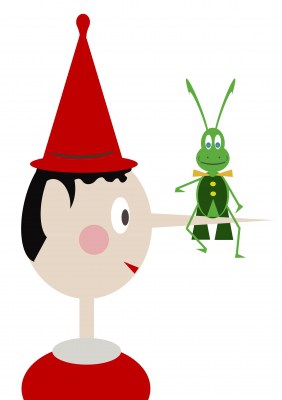
My question here concerns Pinocchio’s nose. Is the nose fictional, but it grows when he tells something fictitious? Linguistic mysteries of the universe, my friends.
I’m literally shaking my head as I write this update. Yes, my head is actually moving back and forth. I know that people have been misusing the word “literally” when they mean “figuratively” in recent years, but breaking grammarian news brings a new, sad twist to the word use saga. Dictionaries have added a definition.
Traditionally, “literally” has meant “actually, without exaggeration or inaccuracy”; “figuratively” has meant “metaphorically, not literally.” You often hear people confusing the words – think Robin Scherbatsky for How I Met Your Mother fans (“That literally blew my mind.”) – but until recently, there was always a right and a wrong. Then came breaking news. Dictionaries have added a new definition to the word “literally”:
“Used to acknowledge that something is not literally true but is used for emphasis or to express strong feeling.”
What? So this second definition is the opposite of the first definition?
Perhaps, the Merriam-Webster and Cambridge dictionaries are okay with this. I’m not especially. It figuratively blows my mind. Any other reactions here?
Maybe you had a teacher who once told you, “Alright is not all right.” The rule still stands, though in the ever-evolving world of words, “alright” seems to be gaining traction – in British English especially according to the experts.
But in 9 out of 10 dictionaries, “alright” is considered a misspelling of “all right.” This common error is seemingly rooted in language patterns used in words such as “already” and “altogether.” However, the two word form is the standard that you should use when you want to appear like you know what you’re doing. And we all like to appear like we know what we’re doing on occasion, right?
As a teenage girl in the 1990s, I was told that my generation over-used the word ‘like.’ And, like, you know what? I think that filler word mentality has translated into today’s writing with the word ‘so.’ (Thanks, again, to one of our readers for, like, bringing this one up.)
So, do you ever start sentences with unnecessary words? Do you realize how much more professional or how much more direct your writing could be if you skipped these hesitation words? Well, you know, I mean, so… yes, it’s true. Be on guard. With Facebook or Twitter, it’s one thing, but in sending an email to your boss, it might, like, you know, look bad. Just another friendly reminder from the K. S. Writing team!
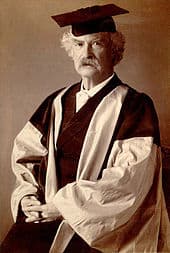
Mark Twain once said, “The dream vocabulary shaves meanings finer and closer than do the world’s daytime dictionaries.” I love this concept, but then again, some people just have nonsensical dreams. In the dream vocabulary of those eccentric individuals is where word pairings like “adviser” and “advisor” must take their roots.
What’s the difference between these two? That’s a great question, and thanks to one of my readers for sending it in. The answer: there is no difference. Don’t you hate that?
“Adviser” is more commonly used and is listed in most dictionaries as the primary spelling. “Advisor” only takes the lead when it comes to official job titles, (i.e. Senior Advisor to the President).
This is up there with other annoying pairings like “preventative” and “preventive.” Those of us who like black and white grammar rules will just have to remain bothered. Though perhaps Mark Twain sums it up best:
“I don’t give a damn for a man that can only spell a word one way.”
Perhaps he’s the best adviser of them all. Happy writing, everyone.
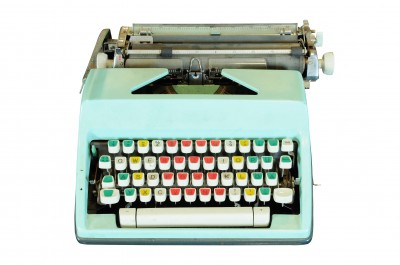
In the days of the typewriter, two spaces were recommended between sentences. Here’s a hint for today’s tip: we’re no longer in the era of the typewriter.
Extra spaces between sentences added readability in the time of monospaced typing (where every letter took up the same amount of space). Few fonts in the digital era follow this spacing style; ergo, the two space necessity has been dropped.
It’s true. Today, most publishers – both print and online – use one space between sentences, and we recommend that you do too. This is especially significant on webpages. Web copy should be direct and concise. Extra spaces clash visually and philosophically with this tactic.
Some writers follow this old rule out of habit; others because they had teachers who taught this form long after typewriters were put to rest. But it’s time now. Typewriters are gathering dust. Don’t let your writing follow suit.
The aroma of imagination can sometimes smell like Hawaiian sweet bread and cranberry stuffing, Thanksgiving turkey, and homemade apple pie. Today was a blissful day as I prepped my recipes for my family’s Thanksgiving dinner tomorrow. It wasn’t just blissful because I was avoiding the papers stacked up by my desk that needed to be graded, but it was blissful because I’m pondering a new book. What better way to brood and mull than while thinly slicing and layering apples into a perfect Thanksgiving pie?
Creation is a process that can feel so wonderful. Today, I watched my recipes move from idea to plan to finished, and I could tell by the way my husband’s head kept turning toward the kitchen that my final products were successful. Why can’t writing be like that?
A hunger pushes us to begin, but a recipe card for the novel you want to write just doesn’t exist. It’s a bit unfair really. Or maybe it’s not unfair. Maybe it’s so gloriously adventurous, so wild, so emancipating, so bohemian… Or maybe that’s just me hyperbolizing to make myself feel better.
This journey that we take to write and to publish is not an easy one. I occasionally have the passing notion to give it up, to wonder about my own sanity to attempt such travails. The self-doubt always passes though. The craving for words always starts once again.
So as I sit waiting on literary agents to profess my brilliance or give me a chance, the new novel brews and bubbles. My summer’s adventures of wading through knee-high grasses to reach ancient castles; of Hungarian restaurant owners feeding us “house specials” of lamb, chicken, and pork with a side of whiskey at 10 a.m.; of bolting at full speed through train stations surrounded by every language but our own; of torrential thunderstorms that didn’t hold us back – we, the ever-determined tourists… Our misadventures all discover their purpose now.
Either way, I wish my computer would occasionally emit majestic fragrances of apple pie and Thanksgiving turkey. That way, I’d know that this next idea or that project I’ve been working on for years has the hope of being absolutely delicious.
Isn’t it weird how characters can take control of a project, and you as the writer are suddenly just a tool in process of creation, like a brush in an artist’s hand? This has happened to me many times through the years, but most recently on a revision of my novel. There were a few tweaks I planned on making, but as I reviewed my pages, strengthening and tightening my prose, my characters unexpectedly began to flirt.
Maybe sitting untouched and lonely in a computer file for months without any attention led them to personal explorations when I wasn’t looking; maybe they just needed time to grow on each other. A major age gap was abruptly forgotten, as the dialogue dripping from my female lead’s tongue was not that of her age. She had been younger this whole time, and I had pigeon-holed her else-ware. The poor woman was probably screaming at me to ID her this whole time, like a girl on the brink of her 30th birthday buying beer.
But now I know. My characters corrected me. Ages now accurate, love interest defined, they flirted and playfully bantered across my pages, creating a sexiness my manuscript had lacked. What fun!
As an update, I finished my edits today. What version of my novel this is I couldn’t tell you, easily past draft five. Looking back, it seems so odd that I felt proud of my “finished” book in the spring of 2008. It was an accomplishment, but now it’s ready… I think… I hope…
Writing: what a beautifully schizophrenic, maniacal process.
When I find myself thinking about writers–about why so many of us are here–I find myself asking why is it that we write? Answering this question is simultaneously simple and impossible, personal and universal.
We write because words make us simultaneously giggle and blubber; we write because we have tiny beings called characters in our heads pounding their miniature fists against our brains as they beg to have their voices heard; we write because when we find words that work well together, we want to marry them on a riverbank on a sunny June afternoon; we write because if we didn’t, we would be pathological liars; we write because we have an odd habit of twisting words like licorice, tweaking, cajoling, poeticizing, intensifying, and making simple sentence structures shine like new; we write because the Muse is calling; we write because a book we read in 3rd or 6th or 11th grade revolutionized the existence of literature in the world; we write because we want to be bestsellers; we write because the world needs to know what we have to say; we write because we have to.
Now, maybe when you find yourself in the midst of accomplished authors, you have a desire to pick their brains like monkeys searching for nits of lice. Maybe with Scarlett O’Hara as your witness, you will never be rejected again, or perhaps you do not want to go gentle into that good write. Curiouser and Curiouser, indeed, I know, but again, it’s a curious journey we embark upon.
Hello world, I have something to say, and you know what? I bet you do too. I, for one, cannot wait to hear what comes out.
 One of these phrases could be used when you’re intensely studying something; the other is what you do when you add milk to your cereal.