I don’t know if this pilot was being reckless, but I do know that he isn’t wreckless.
When you drive, which one of these should you aspire to? Which one should you avoid? Ignoring the fact that only one of these is a real word, I think logic directs you to one side rather than the other.
Hint: a police officer might pull you over for reckless driving, but if you’re a wreckless driver, you won’t have any points taken off of your record.
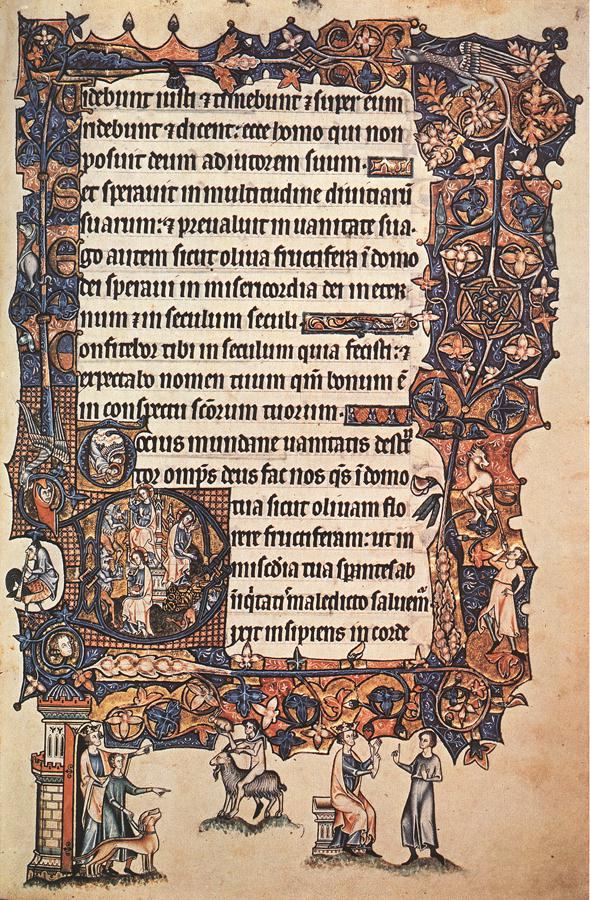
“Look before you leap” is first known to appear in this 14th century manuscript (Ms. Douce) now housed in the Bodleian Library, at Oxford.
Today, like so many days, I urge you to look before you leap.
Maybe it’s a matter of what you choose for breakfast. Maybe it’s what you decide to speak up about to your boss. Maybe it’s a matter of who you decide to vote for.
We make so many decisions big and small on a daily basis, but they can’t all be taken lightly. We can’t just eat our Wheaties because that’s what everyone else is eating or because someone who may or may not have been fully trustworthy told us that this was the best choice for our future health.
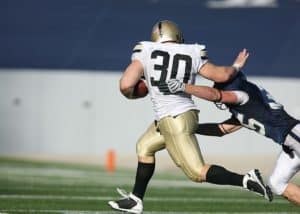
Not on a bye, this guy’s saying “buh-bye” as he runs right by. Maybe he’ll dance to NSYNC in his head when he does his touchdown dance before he buys tickets to Disney World.
Let’s go beyond the double-negative in NSYNC’s lyrics about “it ain’t no lie,” and talk about “bye,” “by” and “buy.”
Here’s a waste that will go straight to your waist (and might leave you slightly nauseated).
It really is a waste if all you can think about is your waist. There are so many better things in the world to think about than something so vain—like kindness, like love, like Shakespeare’s potential co-authors, or even your word choice, for example.
You might have your own waste management practices that include recycling and composting, or you might have your waist management practices which involve sit-ups and some cardio. How are you doing with yours? Actually, don’t answer that. It’s not the point of this conversation. What is important is how you spell these words.
There was a time climbing seemed like a good idea, but if this guy thinks he’s getting down easily, he’s got another think coming.
President Obama has gotten it wrong. Judas Priest has gotten it wrong. Your friends have gotten it wrong on social media (or at least mine have). Do you know the correct version of this idiom?
While “you’ve got another thing coming” might sound better to your ear, the expression is actually “you’ve got another think coming.” As in, “if that’s what you think, you’ve got another think coming.”
Does the correct version make a noun-fussy grammarian shudder? Perhaps. But this correct form dates back at least to the early 1910s and possibly before.
H.L. Menken actually uses it as an example of how words switch parts of speech—from verb to noun, in this case—in his 1921 edition of The American Language, though others have remained disquieted by this use of “think” as a noun.
In 1932, M.H. Weseen used “another think” as an example of wordings that simply aren’t correct in his collection, “Words Confused and Misused.” He didn’t say this, offering “thing” up as the better option. Rather, he just didn’t agree with the use of the expression at all.
And I hear you, Mr. Weseen. The evolution of the English language is a bit strange at times. We can’t always just let new words become standard, but this is one instance of a phrase that has become so commonly used that it is, in the twenty-first century, officially okay.
To be fair, the Oxford English Dictionary has been correcting people about this eggcorn since 1919—though it wasn’t until the 1980s that mass confusion seemed to have set in. I’m looking at you, Judas Priest. Heavy metal and heavy influence apparently.
And did I just say “eggcorn”? Yes, I did, that’s an awesome term that refers to a confused word. Imagine saying “acorn” with a deep southern accent. What would you have? Eggcorn. There’s no such thing as an “eggcorn,” but that doesn’t mean that people won’t call “acorns” by that term. You might hear reference to an “escape goat,” but a “scapegoat” is probably the term that speaker is looking for. We don’t “pass mustard,” unless maybe you’re at a picnic, but you might “pass muster.” Eggcorns one and all. Aren’t you happy we have a word for such things?
Meanwhile, how fun is it to connect Barack Obama to Judas Priest? Obama’s mistake was a passing remark, which I can absolutely forgive. He’s an otherwise eloquent speaker. But Judas Priest? It was a hugely popular song title!
We can do better. We absolutely can. But at least you now know the difference.
Plus who needs seven degrees of separation for Obama and Judas Priest? I did it with a single word. You’re welcome.
You can definitely blame Hollywood for the confusion that’s become commonplace around Mary Shelly’s famous monster. Bookish types and horror aficionados are particular on this point, so it’s time you know the truth.
If you want to go dive in a corral reef, I wonder if you’ve drunk a bit too much tarantula juice after a long day lassoing cows and singing cowboy songs. Don’t dive in the corral. It’ll probably hurt, and there might just be a bull in there that will add to the misadventure.
“Corrals” go with cowboys. Cowboys are often in groups (plural), so the “R”s are too.
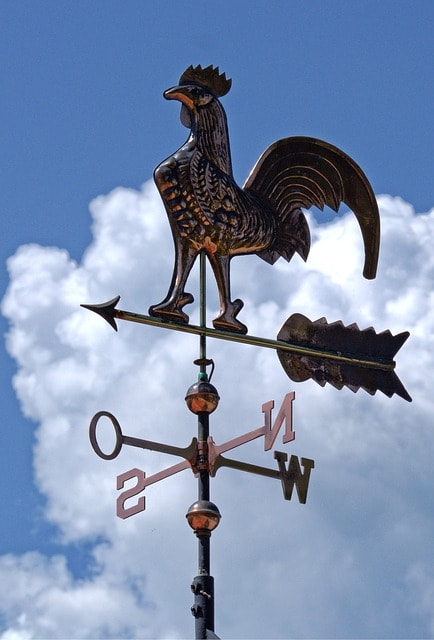
I wouldn’t want to meddle when this metal chicken appeared in my neighbor’s yard. Maybe they earned it somehow in lieu of a medal?
Tough times can show your true mettle, but perhaps if you were a former Olympian, tough times might make you pull out your medal, which is made of metal. I won’t ask you too much about that though, because I don’t want to meddle.
Yes, I could see how these four words could be confusing at first glance. Some mistakes between them might be typos, but often, I believe, it’s an ignorance of the word “mettle.”
Showing your strength and fortitude isn’t showing your metal, even though I could see why some logic might take you there.
Sometimes our characters come to us fully formed like Athena out of Zeus’s head. Other times, it’s not that easy. Let these tips and tactics help you flesh out your characters to make them come alive.



 You can