It’s all about finding your center. (Or something like that.)
Where is the center? In the middle, right? So how can the center be around something? Aren’t these two concepts a bit of an oxymoron when placed next to each other? You’re either at the center or you’re around. Will everyone please stop saying and writing “centered around” now?
Shoo, shoe. Stop photobombing the picture! (A shoo-in for a photography award? Probably not.)
Are we talking about wedging a foot into a doorway or about shooing something in a certain direction? Do you know?
When this expression is spelled wrong, it’s almost justifiable. To “get a foot in the door” is a common idiom, and this one could be related… But it’s not.
“Anytime” is a relatively new word—yes, we’re calling early 20th century “recent” for the sake of this linguistic argument. And you know that any time there is a new word, there’s going to be a grammarian hullaballoo. Here’s just another example.
When does he walk in the middle of the road? Anytime he wants to. He’s a rebel like that. Linguistic and otherwise.
“Anytime” (one word) is considered a casual form, not one for your résumé or emails to advance you up the corporate ladder. In fact, this one-word form is still not recognized by some dictionaries. (I’m looking at you, OED). “Anytime” technically is defined as an adverb meaning “whenever” or “on any occasion,” but as a new word, it is young and defiant, having other meanings too. “Anytime” can also simply mean “No problem,” in response to a “thank you.”
If you aren’t sure if you can get away with “anytime” vs. “any time,” ask yourself if you can replace the word in question with “at any time.”
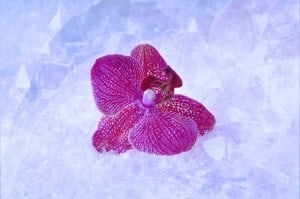
Maybe the only way this flower is alive in the snow and ice is because it’s deep-seeded. No? Yeah, I don’t think so either.
No matter how much the weather makes you feel like gardening (or perhaps not…), there is nothing tracing back to seeds, roots, or things buried far within the dirt with this idiom.
If you have a belief that is held deep in your core, it is “deep-seated”—as in seated deeply within your heart. (Note, there’s a hyphen present since these two words are combining to become an adjective.)
You don’t want to bury your seeds too deeply or they won’t grow. The same goes for this idiom. No more deep seeding, everyone. “Deep-seated” is the way to go.
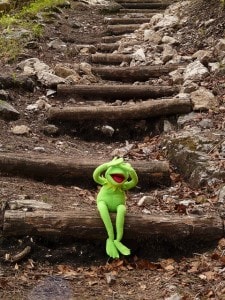
Kermit doesn’t like extra words in sentences either.
Words are so much fun sometimes that we often add them in nonsensically, letting them land where they may. Sometimes we stick extra words into sentences where they really have no point. That’s exactly the case when it comes to “equally as.”
Hint: There’s no point to the word “as” next to the word “equally” in most instances. Please clean it up if it spills onto your keyboard.
For example:
The twins were equally tall.
The pigs in space were equally smart.
The muppets were equally hilarious. (Strike that sentence; it’s not true. Sorry, Fozzy.)
Do you see how “as” is never needed in these cases? Yet writers add this little word in all of the time. Why is that? Where did it start? When will it stop?
Admittedly, in instances where you are writing “equally as (adjective) as ____,” making a comparison in the latter half of the sentence, the “as” works–though in this case, there would be two “as”es in the sentence, never just one. I repeat, never just one. Here’s a little grammatical instance of how change can start with you.
Mozart composed the Prague Symphony, and many stones compose this bridge in Prague.
100 writing tips compose my book, Alright? Not All Right. My book comprises 100 writing tips. There’s a subtle difference between these words that is essential in mastering their usage. Are you getting them right?
Ignoring other meanings for a moment, let’s focus on when “compose” means “to come together to form something.” Thus, little pieces come together to make something big. Words compose a page; planets compose the solar system; trees compose a forest.
To comprise means “to contain,” so to use it properly, something big must contain smaller parts. The library comprises books; molecules comprise atoms; the “dead poets society” did not comprise dead poets (or maybe it did have one. Oh, I just got sad… good movie).
Maybe you have a love of magic. Maybe you had that uncle who always pulled a coin from your ear. Maybe you always cheat at cards (shame on you). Whatever the case, make sure you’re writing the correct idiom.
Sleight of hand is the correct way to write this phrase. The word “sleight” doesn’t get much use these days, but it means “dexterity” or “cunning.”
If you were writing about “slight of hand,” then that would mean small or feeble hands, but I don’t think that’s what you’re aiming for.
Got it?
Writing Tip 147.2: Sleight of hand is also known as “prestidigitation.” Say that ten times fast, I dare you.
You know who could care less? This little guy. But. It’s. So. Hard… Squirrel!
Hint: if you’re talking to a writer or editor, even on social media, try hard to get this phrase right. Heck, if you’re talking to anyone, it’s worth knowing the difference.
If you couldn’t care less about something, that means that you already care so little about the subject that it’s impossible for you to be interested in it even less than you already are. I couldn’t care less about calculus. Or glittering vampires. Or most forms of reality tv. (Sorry, but it’s true).
If you could care less about something, then that means that you do indeed care about it. You maybe aren’t singing it from the rooftops, but there’s room for less interest. And maybe you are singing it from the rooftops; that’s possible too.
This is a writing and speaking tip really. I have faith you can get it right. I’d say I couldn’t care less if you do, but I just do. I really, really do.
I don’t know about you, but I’m pretty sure this owl is up to something. And I might be a little scared.
If you were a magical being and you were to “extract revenge” from some cauldron of calamity, maybe you’d be using your words correctly. However, for most writers plotting vengeance for their characters (or themselves?), the proper idiom is “to exact revenge.”
***insert menacing music here***
Revenge is a delicate subject. I could see how handling it properly seems like something you might do with a pipette and a beaker, but that’s just not the case.
To “exact revenge” calls back upon an old usage of the word “exact,” specifically to both demand and obtain, most commonly by force. Yikes. A bit more intimidating than pipettes, right?
One could exact payment, exact change, exact meaning, or exact justice. There are many things to exact, when you begin thinking of this word as a verb. It’s all a matter of being exact with your usages of exact. Are you ready to get this exactly right?
The proper phrase is “hunger pangs.” What is a “pang” you ask? Why a brief feeling of emotional or physical pain, of course. Confusing? Absolutely.
The muddle over the “hunger pangs” vs. “hunger pains” is understandable, but when there’s a correct answer, you’ve got to go with it.
You might have back pains, growing pains, or pains in the neck, but you don’t have “hunger pains.” Unless there’s major malnourishment involved, “pang” is the word you need.