Writing Tip 68: The “i” before “e” except after “c” Challenge
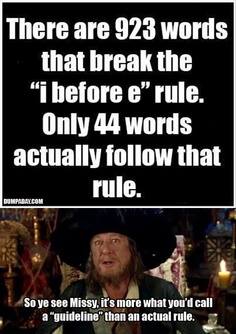 Recently, a challenge was thrown down from one of you. And you know me; I can’t ignore a good writing dispute. It’s like a double-dog dare in the school yard–just switch out the bold kid with me sitting at my computer, glasses on, jaw steeled with determination. (An intimidating picture, I know)
The claim states, “There are 923 words that break the ‘i’ before ‘e’ rule. Only 44 words actually follow that rule.”
For the sake of a writing tip, let’s take a moment to get into the nitty gritty fine print that this statement ignores. The “i” before “e” except after “c” rule applies only to words where the “ie” makes the “ee” sound (e.g. “achieve,” “piece,” “belief,” “receive,” “ceiling,” “receipt,” etc.). Some spelling textbooks even record this as part of the rhyme:
I before E except after C,
When the sound is “ee”
With this clarification, many of the aforementioned 923 words become less defiant.
- Words like “science” or “efficient” – where the “i” follows the “c” – have a different sound.
- Words like “beige,” “neighbor,” “height” and “weight” – with their rebellious “ei” form not following a “c” – also break the rule, but their vowel combination sound is also not an “ee.”
There continue to be exceptions, though. If you really want to get technical, you can learn the specific categories where the “ei” is correct when it makes the “ee” sound, even when it doesn’t follow a “c”:
- Proper names, such as “Keith” or “Sheila”;
- Chemical names, such as “caffeine”;
- Plural forms of words that end in “-cy,” such as “tendencies”
No, this list doesn’t cover them all. Keep in mind the challenge wasn’t to break this down in an understandable manner.
Let’s return to that challenge. I indeed solved it. The total of 923 words that break the rule is incorrect. It’s actually more. (Didn’t see that one coming, did you?) QI, a quiz show on BBC, reported the 923 figure as determined by Scrabble experts, but this is the number of words that end in “-cie.” Add in all of the “e” before “i” words that don’t follow a “c” and you’ve got yourself an even more striking number. What that number is, I don’t know, but I’m sure it’s impressive.
So there you go, shocking grammar meme debunked. As for the “i” before “e” rule… it’s catchy but it might not be as helpful as we thought it was in elementary school.