Don’t you love a good mystery? I know I do, although sometimes the writing and editing process seems a bit mysterious in itself. There are the mysteries of how the words move from your mind to fill the page, mysteries of the Muse (if one believes in such things), and maybe even mysteries over the placement of proper punctuation.
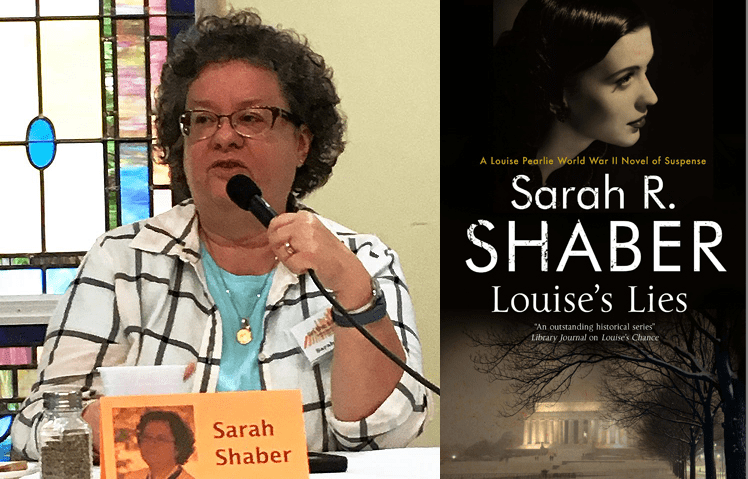
So what better person to talk about the mysteries of craft than an award-winning mystery writer with thirteen books and countless short stories to her name? Today, the talented (and always hard at work!) author Sarah R. Shaber allows us a glimpse into her writing and editing process.
Some astronauts are down-to-earth; others need to be pulled back down to earth. Here’s hoping this guy doesn’t literally need to be pulled back to Earth.
Do you feel the earth move under your feet? How about the sky tumbling down, tumbling down?
Are you singing along in your head, or are you really just nervous about your grammar? Do you know when to capitalize the “e” in “Earth” or when to leave it in lowercase?
We all know the name of the third planet from the sun, but the proper noun vs. common noun confusion is an understandable one. Sometimes, we see it written as “Earth,” and sometimes, it’s just plain “earth.”
Here’s the quick “earth” capitalization breakdown:
When I first mentioned this interview series—talking to professional writers about their editing processes—many I spoke with immediately jumped to “authorship” in terms of books. But you know what’s awesome about creatives? There are a lot of us, and we’re just about everywhere. We’re hunched over our laptops in coffee shops; we’re staring out windows at the falling rain; and we’re even in offices with conference rooms and break rooms and, if we’re lucky, ping pong tables. (Yes, ping pong tables.)
Some writers, in fact, don’t have to quit their day jobs to unleash their creativity, because writing is their day job. One such talented wordsmith was recently kind enough to let me pepper her with questions about editing and grammar.
Sara Grunden Kuhs is a senior copywriter at The Martin Agency in Richmond, Virginia where she’s worked with many national brands over the last 12 years. She got her masters from VCU Adcenter (now Brandcenter) and did her undergrad at DePauw University in Indiana, majoring in writing and minoring in philosophy and psychology. In her spare time, she and her husband like to bowl, cook, wear hats, and entertain their two German Shorthaired Pointers.
A well-crafted phrase gives me the same reaction as taking that first bite into a really good cheesecake. I want to forget everything else just for that one moment and simply enjoy it for all of its luscious, delectable splendor.
As writers, many of us strive for that perfect word or that perfect line; however, poetry is an art-form focused on each and every bite. Those who can weave language, rhythm, and meaning are the ones who make me salivate and make me want to beg for their recipes.
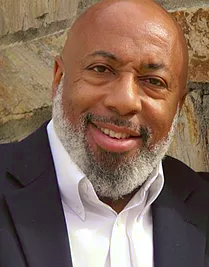
I’m thrilled that Nathan M. Richardson, a man of many talents as a poet, a performer, and a teacher, took the time to chat with me about his writing and editing process. A reviewer of his book, Likeness of Being, once said, “This is more than a book of poetry, this is a book that resonates with the soul on a deep level.” I’d argue the same about Nathan himself.
Nathan M. Richardson is an accomplished performance poet and published author. His published collections are “Likeness of Being” and “Twenty-one Imaginary T-shirts.” He has also contributed to the following anthologies: The Poets Domain, The Cupola, The Channel Marker & Skipping Stones. Nathan teaches a variety of workshops for emerging writers and is the Head Coach of the Hampton Roads Youth Poets a division of the youth empowerment organization—Teens with a Purpose.
Demonstrating his ability to switch hats from poetry and storytelling to history and theater, Nathan is preparing for his 3rd year of The Frederick Douglass Speaking Tour, in which he delivers a remarkable portrayal of the former slave, writer, orator, and abolitionist Frederick Douglass. A short list of Nathan’s other affiliations include the Poetry Society of Virginia, Young Audiences of Virginia, and the Suffolk Arts League.
One of them has to be an impostor–uh, imposter?–right?
When I came across one version of this word recently, I did a double-take. It simply didn’t look right to me, and as an editor, I like to be thorough. I can’t let typos slip through my grasp—even if Microsoft Word allows them. (It happens more than you might think.)
So I did my research and learned “imposter” was not the impostor I thought it was. It’s entirely acceptable. Both the “impostor” and “imposter” spellings are considered correct, and “imposter” even has an edge in Australia and New Zealand.
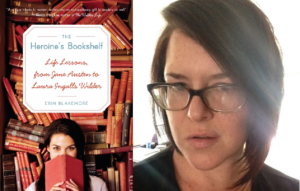
Back in 2012, someone put Erin Blakemore’s book, The Heroine’s Bookshelf: Life Lessons, from Jane Austen to Laura Ingalls Wilder, in my hands, and I gobbled it up like a guilty pleasure. When it comes to the classics, we all have our favorites, and many of mine include heroines that simply cannot be forgotten. They are power houses of strength—whether they seem it or not, whether they themselves realize it or not. The Heroine’s Bookshelf analyzed so many characters I knew so well that I could practically call them friends and allowed me to revisit each of them in a new light.
The best books are the ones that stay with you long after you close their pages. Ironically, Erin’s book about so many books had that same effect on me.

 Sara Grunden Kuhs is a senior copywriter at
 I’m thrilled that Nathan M. Richardson, a man of many talents as a poet, a performer, and a teacher, took the time to chat with me about his writing and editing process. A reviewer of his book,